China recommends 30 carbon-footprint rules for cotton yarn, nickel, cables and other products
Four Chinese government agencies published a fourth batch of methods for calculating the carbon footprint of industrial products, bringing the total to 141. They are industry-association standards on a recommended list, not mandatory rules; a separate plan targets more than 100 national standards by 2028.
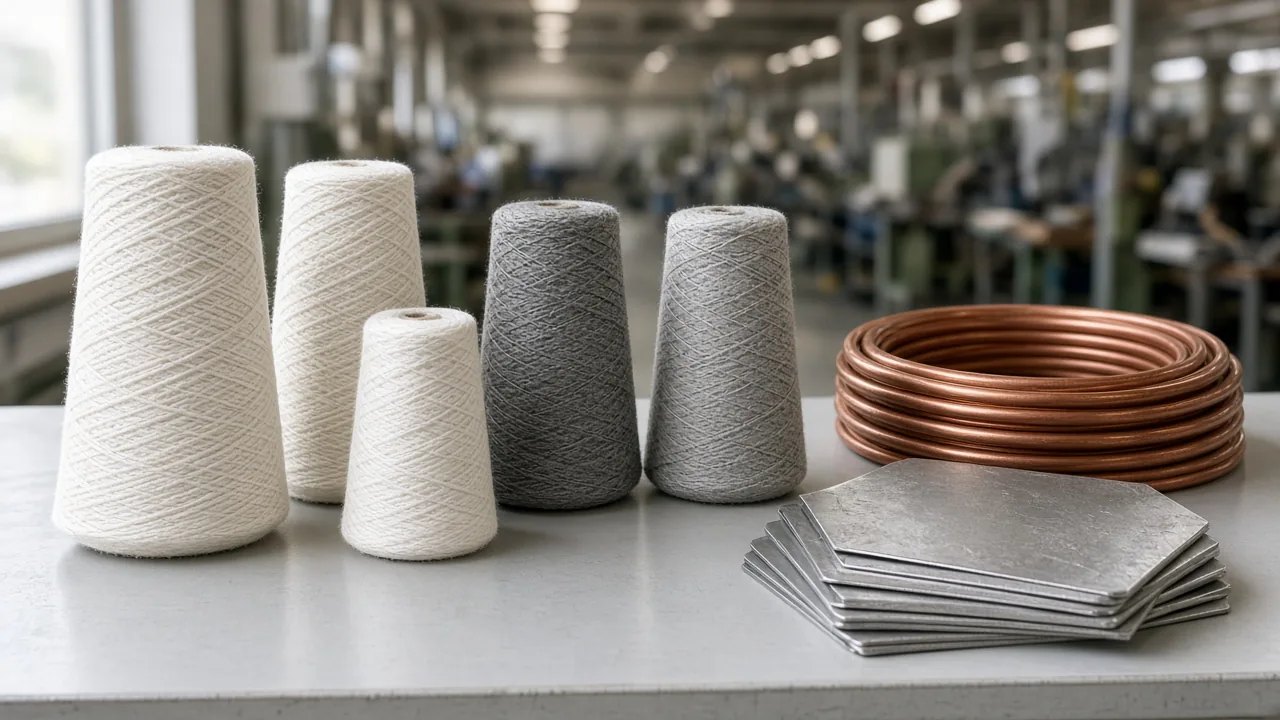
What was published? China has expanded its official list of methods for calculating the carbon footprint of industrial products. The Ministry of Industry and Information Technology (MIIT), the Ministry of Ecology and Environment (MEE), the National Development and Reform Commission (NDRC) and the State Administration for Market Regulation (SAMR) published on November 10 notice No. 384 of 2026, dated November 6, with a fourth batch of 30 recommended industry-association standards (团体标准). According to the notice, the standards went through nomination by standardisation bodies, expert review and online public notice. The text cites the government’s 2024 work plan for controlling the total amount and intensity of carbon emissions.
Which products are covered? The batch spans textiles, metals, chemicals and electronics. In textiles, it covers cotton yarn, colour-spun yarn (色纺纱) and dyed and printed fabric of chemical fibres and blends. In metals, it covers tin ingots, electrolytic nickel, electrowon cobalt, rare-earth products from hydrometallurgy and pyrometallurgy, welded steel pipe and metallurgical lime. It also includes wires and cables, nickel-metal hydride batteries, PVC film and sheet flooring, disposable hygiene products, adhesives, lubricants, rubber and plastics machinery, bamboo building products, speakers, scanners, anti-static floors and workbenches, telecom equipment, ships and rockets.
What does a figure calculated under these rules measure? It depends on each standard, and the full text of all 30 can be downloaded from the MIIT website. The cotton yarn standard (T/CNTAC 239-2025), issued by the China National Textile and Apparel Council on September 12, 2025, calculates the footprint per tonne of yarn, in kilograms of CO2 equivalent, from raw-material acquisition through manufacturing to delivery. Use and disposal fall outside that boundary. The standard builds on China’s national standard GB/T 24067 and cites ISO 14026:2017.
Are these rules mandatory? No. The notice publishes a recommended list, and industry-association standards are voluntary. The plan for national standards also uses only recommended standards, with the GB/T prefix, the same as the new sportswear standard in force since November 1. With this batch, the list reaches 141 methods: 15 in the first batch (January 2025), 23 in the second (June 2025), 73 in the third (January 2026) and now 30 (CSP tally).
What comes next? SAMR, NDRC, MEE, MIIT and the National Energy Administration issued a 2026–2028 plan, dated October 19 and announced on October 30, that targets more than 100 national carbon-footprint standards across energy, raw materials, consumer goods, machinery and equipment, and transport vehicles. Its annex lists 175 recommended national standards; cotton textiles and apparel are due in 2026, and footwear in 2027. The plan asks for national standards to be aligned with the work on association standards, for some to be developed in step with international standards, and for China to seek mutual recognition with other countries’ standards.
CSP view: for importers of cotton yarn, fabric, nickel or cables from China (yarn and fabric are part of the country’s textile and apparel exports), the question for the supplier is no longer just “what is your carbon footprint”. It is worth also asking for the standard used (the T/... code), the declared unit, the calculation boundary and whether a third party verified the figure. A number calculated under a recommended Chinese standard is not automatically accepted by another country’s rules or by a customer’s climate programme; that should be checked before the figure goes into a report or contract. This reading is ours, not the Chinese agencies’.
Original sources
- MIIT, MEE, NDRC and SAMR: notice No. 384 of 2026 on the fourth batch of industrial product carbon-footprint standards (工业和信息化部等四部门关于公布工业产品碳足迹核算规则团体标准推荐清单(第四批)的通告), 06/11/2026
- MIIT: full texts of the 30 standards in the fourth batch (工业产品碳足迹核算规则团体标准推荐清单(第四批)标准文本查阅), 10/11/2026
- MIIT, MEE, NDRC and SAMR: third batch, 73 standards (工业产品碳足迹核算规则团体标准推荐清单(第三批)的通告), 26/01/2026
- MIIT, MEE, NDRC and SAMR: second batch, 23 standards (工业产品碳足迹核算规则团体标准推荐清单(第二批)的通告), 27/06/2025
- MIIT, MEE, NDRC and SAMR: first batch, 15 standards (工业产品碳足迹核算规则团体标准推荐清单(第一批)的通告), 15/01/2025
- SAMR: five agencies issue the 2026–2028 action plan on carbon-footprint standards for key products (重点产品碳足迹标准体系建设行动方案(2026—2028年)), 30/10/2026
- Hong Kong Trade and Industry Department (TID), circular No. 979/2026 with the text of the 2026–2028 plan, 10/11/2026
- Securities Times (证券时报网), via 10jqka: 30 standards in the fourth batch of carbon-footprint rules (30项上榜 第四批工业产品碳足迹核算规则团体标准推荐清单公布), 11/11/2026
CSP take marks the newsroom's interpretation; everything else comes from the cited sources.
Read next
 Trade policy
China issues new outbound investment rules, effective December 1
 Electronics & chips
China requires AI-agent checks in network-access approval for phones, tablets and wearables
 Textiles & apparel
China scraps standard used to sell wool as “sheep cashmere”
More in Trade policy
- CIIE closes with a record $85.45 billion in intended deals, but growth slows to 2.3%
- China's central SOEs raise CIIE purchase intentions for South American goods by 45%
- China formalises suspension of rare earth and lithium battery export controls until 10 January 2027
- China keeps special port fee on US-linked ships suspended until 10 January 2027
- China extends suspension of 24% tariff on US goods by two months and keeps the 10%
Sourcing Briefing
What changed in China sourcing, in your inbox every weekday.