China's car exports jump 68% in October and now make up 35% of automakers' sales
Exports of new-energy cars (battery-electric, plug-in hybrid and range-extender) more than doubled to 582,000 while retail sales in China fell 27%. CPCA expects exports to cool from November after front-loaded shipments.
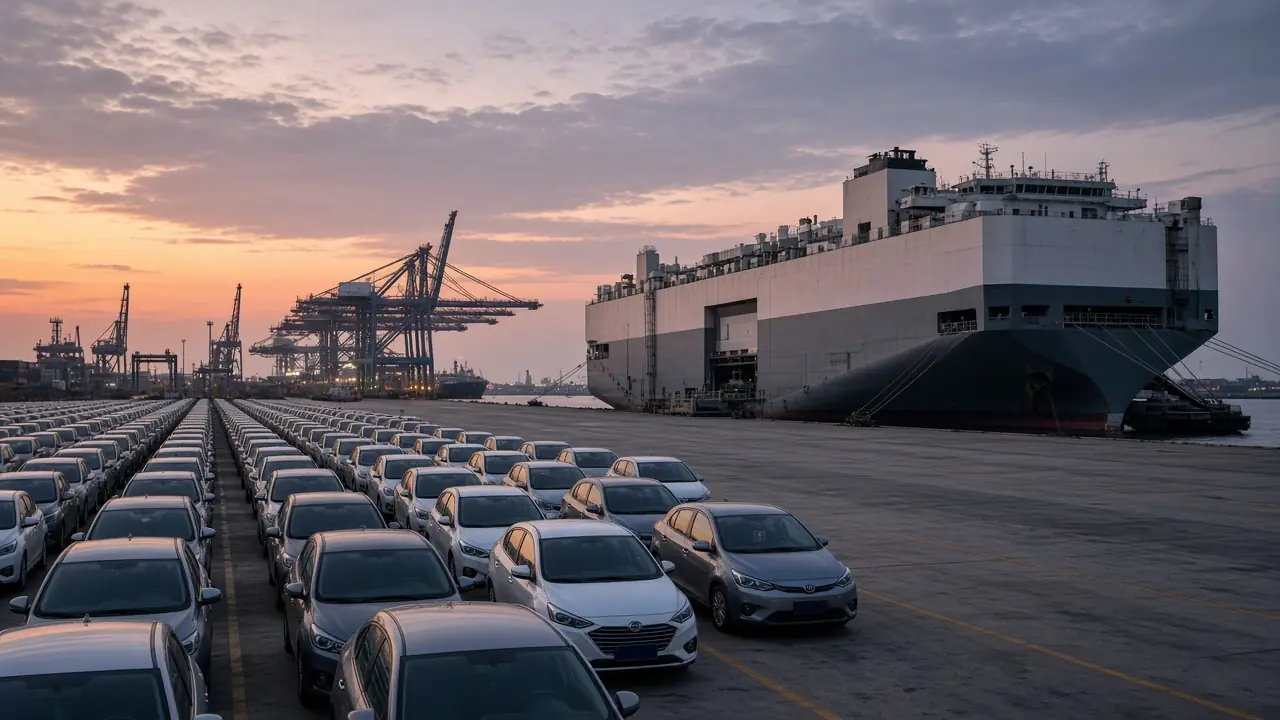
Chinese automakers exported 928,000 passenger cars in October 2026, counting built-up vehicles and kits for local assembly (CKD), up 68.5% from October 2025 and 1.0% from September, according to the monthly analysis of the China Passenger Car Association (CPCA, 乘联分会) released on 9 November. Exports equalled 35% of automakers' sales in the month, against 36% in September and 19% a year earlier. Chinese brands exported 810,000 units (+77%) and joint-venture and luxury brands 118,000 (+28%). CPCA also released a broader figure ("广义乘用车") of 932,000 units (+68.2%), which is the one cited by some international agencies; we use the 928,000 figure here because it is the basis for the breakdown below.
New-energy vehicles (NEVs, which in China cover battery-electric, plug-in hybrid and range-extender models) accounted for 582,000 exports in October, up 144.7% year on year and 3.9% month on month, and made up 62.8% of all passenger-car exports, 20 points more than a year earlier. From January to October, passenger NEV exports reached 4.472 million, up 139.7%. Combustion-engine car exports were 346,000, up 11% year on year and down 4% month on month.
By technology, battery-electric cars were 61.7% of NEV exports; plug-in hybrids 33.7%; and range-extenders 4.6%. Among battery-electric cars, A00 and A0 models (mini and compact) reached 56.4%, against 42.1% in October 2025. The largest NEV exporters in the month were BYD (165,194), Chery (83,843), Geely (80,119), Tesla China (59,012), SAIC Passenger Vehicle (42,030), Changan (30,343), Leapmotor (21,132), SAIC-GM-Wuling (16,866), XPeng (13,326), GAC Aion (12,150) and Great Wall (12,029). CPCA highlights the share of CKD kits in some brands' exports: SAIC-GM-Wuling 41.9%, Great Wall 31.1%, SAIC Passenger Vehicle 27.6% and Leapmotor 8.0%.
The contrast is with the home market. Passenger-car retail sales in China were 1.643 million units in October, down 27.1% year on year (+1.5% month on month), and 14.978 million year to date (−22.3%). Automakers' wholesale shipments fell 10.2% to 2.633 million, a decline 16.9 points smaller than retail's; CPCA attributes that gap to the surge in exports. The association calculates that exports were 40% of automakers' wholesale combustion-car sales (24% a year earlier) and 33% of their NEV wholesale (15%); for luxury NEVs, 78% of automakers' sales.
For November, CPCA expects exports to fade gradually: cars for Christmas sales abroad need to ship early, with the window concentrated before mid-month. The association says front-loading will be stronger this year because an expected cut in export tax rebates coincides with tariff windows narrowing abroad. According to CPCA, this lifts short-term numbers but uses up part of next year's first-quarter export demand.
On a different basis, customs data up to September, the same CPCA analysis shows Brazil as the top destination for Chinese new-energy vehicles (all vehicle types, not only passenger cars) from January to September 2026, with 379,234 units, ahead of Belgium (351,032) and the United Kingdom (313,638). These numbers use a different basis and are not comparable with the October figures above.
CSP analysis: China's car industry is selling abroad what it cannot sell at home, above all small EVs and plug-in hybrids. For importers and distributors, that means more supply and more brands chasing the same market, which favours buyers negotiating volume. CPCA's warning about front-loaded shipments suggests the pace may slow in early 2027. The tax-rebate cut is an expectation cited by CPCA, not an announced official measure. This reading is ours, not CPCA's.
Original sources
- CPCA (乘联分会), lista de análises: 【月度分析】2026年10月份全国乘用车市场分析, 09/11/2026 (página do texto completo não acessível a partir da nossa rede)
- CPCA (乘联分会): 2026年10月份全国乘用车市场分析, 09/11/2026, reproduzido por Mysteel (我的钢铁网)
- IT之家: 乘联分会:10月新能源乘用车出口58.2万辆同比增长144.7%, 09/11/2026
- IT之家: 乘联分会:10月全国乘用车市场零售164.3万辆,同比下降27.1%, 09/11/2026
- 爱集微 (ijiwei): 乘联分会:10月乘用车零售164.3万辆同比下降27.1%, 09/11/2026
- Securities Times / 人民财讯 via Sina Finance: 乘联分会:10月新能源乘用车出口58.2万辆, 09/11/2026
- 钛媒体 (TMTPost), citando o canal oficial da CPCA: 乘联分会:10月乘用车出口达92.8万辆,新能源出口同比大增144.7%, 09/11/2026
CSP take marks the newsroom's interpretation; everything else comes from the cited sources.
Read next



Sourcing Briefing
What changed in China sourcing, in your inbox every weekday.