Drinda scraps 5 GW Oman solar cell plant, citing Beijing’s planned tech export curbs
The board of the Chinese solar cell specialist ended the US$280 million project in Oman’s Sohar Free Zone on November 12, before substantive construction began. One of the five reasons it gives is Beijing’s proposal to add PV technology to its export-control catalogue; exporting the listed technologies already requires prior registration.
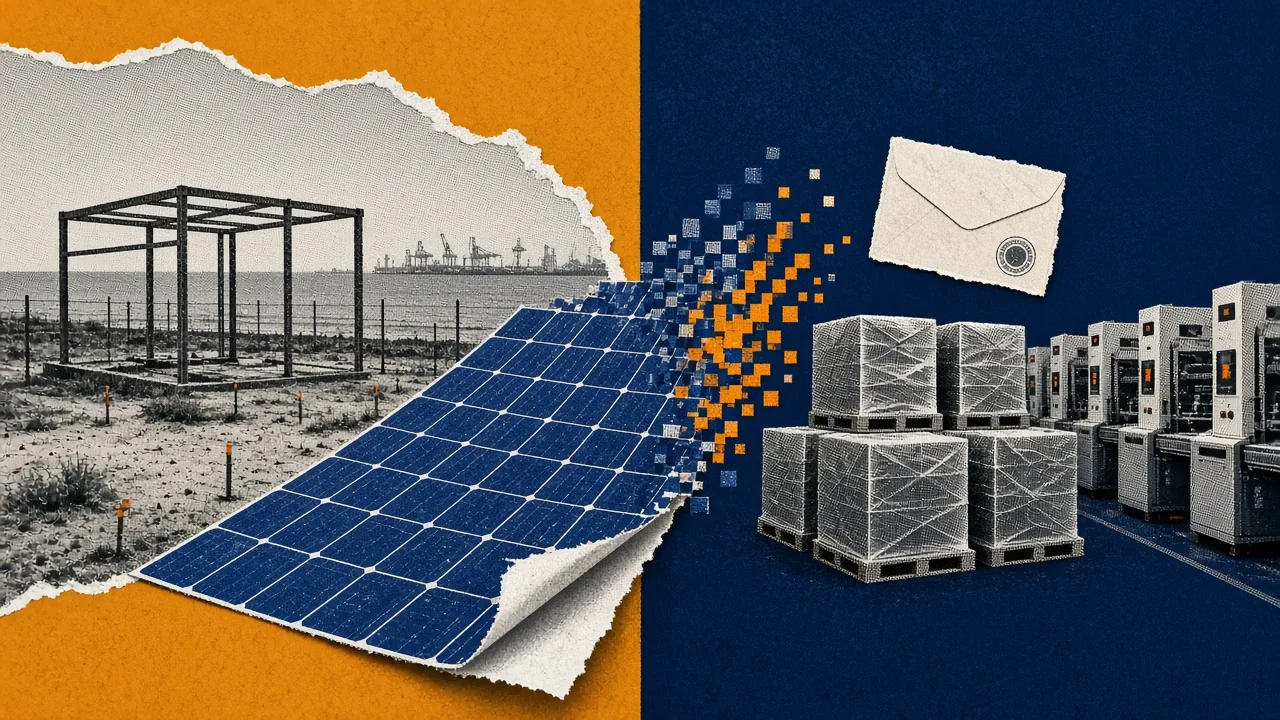
What did Drinda decide? It has dropped its planned cell factory in Oman before building it. On November 12, the board of Hainan Drinda New Energy Technology (钧达股份, listed in Shenzhen as 002865 and in Hong Kong as 2865) approved ending the project for a high-efficiency solar cell base with 5 GW of annual capacity in Oman’s Sohar Free Zone. With planned investment of about US$280 million, the plant was meant to use the free zone’s location and trade-policy advantages to serve the Middle East, Europe and other overseas markets, the company said in its Hong Kong filing. Substantive construction had not begun, and investment to date was minimal.
Why did the project stop? The company gives five reasons, which it dates from the second half of 2025. International trade rules and tariffs kept changing. Geopolitical uncertainty in the Middle East rose, especially with the large-scale military conflict in the region since the end of February 2026. Oman’s local supply chain for main and auxiliary PV materials developed more slowly than expected. Several rounds of talks with potential investors and partners produced no joint scheme. And in October, China’s Ministry of Commerce (MOFCOM) and Ministry of Science and Technology proposed adding PV technologies to the catalogue of technologies prohibited or restricted from export, including the key equipment that carries them, with temporary registration for such exports in the meantime. Drinda says this made equipment supply, the timeline and investment costs less certain. Notice No. 48 covers 12 technologies in polysilicon, wafer and cell manufacturing, and public comment closes on November 15.
Where does the money go? Into Drinda’s existing cell business and into raw materials. Of the HK$968.75 million from its 2025 Hong Kong share offering earmarked for the overseas plant, HK$5.98 million had been used. The board wants to redirect the remaining HK$962.77 million: HK$577.66 million to cell R&D, technology upgrades and revamping production lines, HK$288.83 million to strategic purchases of cell raw materials and HK$96.28 million to working capital, all by December 31, 2027. The company says silver paste and silicon wafers, key inputs, show significant price swings, and it wants to buy ahead to lock in costs. The new use of the money needs approval at an extraordinary general meeting; the termination itself does not.
What changes for buyers? A planned source of cells made outside China for the Middle East and Europe is gone. On November 6, asked on an investor platform about Oman, the company said it was reassessing the project because of the trade environment, tariff policies and regional geopolitics, and that a cell base in Türkiye in which it holds a stake had reached stable mass production. Demand in the region is there: Saudi Arabia was the second-largest destination for Chinese modules in September, according to InfoLink data.
CSP view: here a listed Chinese company names Beijing’s proposed controls on PV technology exports as one reason to drop a factory abroad. For buyers negotiating with Chinese manufacturers to build cell or module capacity in Brazil, the Gulf or elsewhere, the practical question is whether the technology and equipment fall under the registration Beijing already requires, or under a licence if the catalogue is adopted, and who carries the delay. Moving cash into silver paste and wafers also shows a cell maker preparing for input price swings that can reach cell and module quotes. This reading is ours, not Drinda’s.
Original sources
- Hainan Drinda New Energy Technology: announcement on the change in use of net proceeds from the global offering and termination of the Oman project (HKEX), 12/11/2026
- Yicai (第一财经): Drinda terminates its 5 GW Oman high-efficiency cell base project (钧达股份终止阿曼年产5GW高效电池生产基地项目), 12/11/2026
- National Business Daily (每日经济新闻): Drinda ends 5 GW Oman cell project (钧达股份终止阿曼5GW高效电池项目), 12/11/2026
- 10jqka (同花顺): Drinda reply to investors on its Türkiye cell base and the Oman project, 06/11/2026
- MOFCOM and Ministry of Science and Technology: Notice No. 48 of 2026 on revising the catalogue of technologies prohibited or restricted from export, with temporary registration, 16/10/2026
CSP take marks the newsroom's interpretation; everything else comes from the cited sources.
How to cite: China Sourcing Post (chinasourcingpost.com), “Drinda scraps 5 GW Oman solar cell plant, citing Beijing’s planned tech export curbs”, 2026-11-12. https://chinasourcingpost.com/en/news/drinda-scraps-oman-solar-cell-plant-china-tech-export-rules/
Read next
 Energy & solar
Chinese polysilicon holds at 43,000 yuan a tonne as plants cut output
 Energy & solar
At CIIE, Chinese power contractors sign purchase agreements with Siemens Energy, Hitachi Energy and GE Vernova
 Energy & solar
Brazil is the No. 3 buyer of Chinese solar modules in September, driven by an import quota
Sourcing Briefing
What changed in China sourcing, in your inbox every weekday.