China’s glass-fibre cloth for circuit boards rises again in November
November prices compiled by consultancy SCI99 show a 1.5-yuan-per-metre rise in 7628 cloth, used as reinforcement in circuit-board laminates. Industry companies say they are running at full capacity, and one executive expects new capacity only in the second half of 2027.
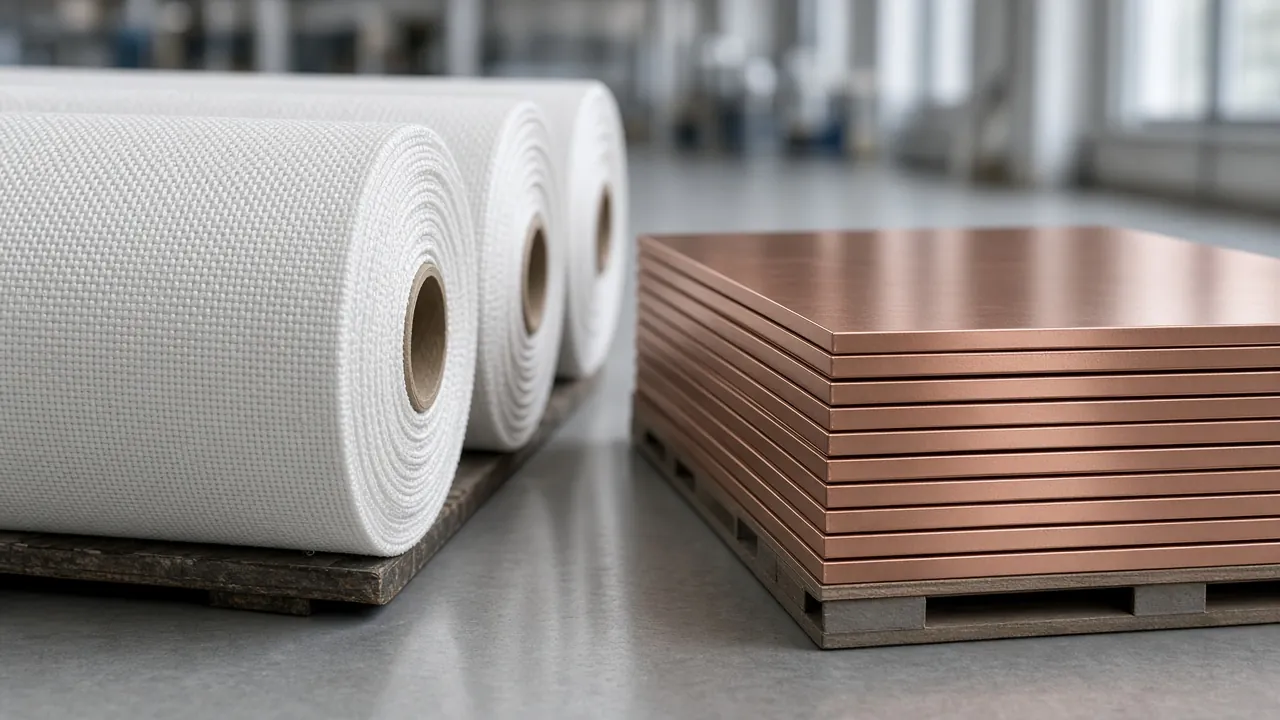
November prices for electronic glass cloth (电子布) and electronic glass yarn (电子纱) in China rose again. The figures come from Chinese consultancy SCI99 (卓创资讯) and were reported on November 3 by the country’s financial press. Thick 7628 cloth was quoted at 14.60–14.65 yuan per metre, 1.5 yuan above October. Among thin cloths, 2116 went to 20.2 yuan per metre (up 2.5 yuan) and 1080 to 20.75–20.80 yuan (up 2.5 to 2.6 yuan).
Yarn also rose. G75 went to 28,750–28,850 yuan per tonne (up 3,000 yuan), E225 to 71,500 yuan (up 10,500 to 12,500 yuan) and D450 to 147,500 yuan (up 27,750 yuan). Electronic cloth is woven from electronic-grade glass-fibre yarn and reinforces copper-clad laminate (覆铜板, CCL), the base of the printed circuit board. High-end grades, such as low-dielectric and low-expansion cloth, mainly serve artificial-intelligence servers and switches, according to 21jingji.
The rise has been long. According to a figure cited in a China Securities Journal report on October 19, 7628 cloth cost about 3.9 yuan per metre in September 2025 and had stayed between 3.6 and 3.9 yuan for the previous two years. On October 29, Liu Yang, a glass-fibre analyst at SCI99, told the paper that prices were at their highest in nearly ten years, with even bigger increases for ultra-thin, high-frequency and low-dielectric cloth.
Several listed industry companies interviewed by China Securities Journal on November 3 said prices follow the market, that November is still rising and that plants are running at full capacity. One said that, conservatively, the upcycle lasts at least until the end of 2027. An executive at a high-end cloth maker said the industry’s new capacity will only come online, gradually, in the second half of 2027. Chongqing Polycomp International (CPIC, 国际复材) said supply remains tight in the artificial-intelligence segment and that it is producing at full capacity.
The cost reaches the board. A laminate-maker executive told the paper that cloth makes up about 20% of a laminate’s raw materials, second only to copper foil, and that costs pass relatively smoothly from cloth to laminate to circuit board. On October 13, Kingboard Laminates, part of the Kingboard (建滔) group, announced a 15% increase for laminates and prepregs (PP) made with 2116 or thinner cloth, effective for orders from that date. The company cited strong demand for thin cloth and tight, sharply pricier supply of glass cloth and yarn. It was the company’s eighth increase this year, according to Yicai.
Pass-through is not uniform along the chain. According to China Securities Journal, the laminate industry is concentrated while circuit-board making is more fragmented, and the two pass on prices differently. An executive at a large board maker said bigger companies usually have several laminate suppliers, which keeps supply stable, and have some ability to pass on prices, depending on demand. In October, a distributor told the paper that cloth makers mainly serve large and mid-sized laminate producers; smaller ones buy from large manufacturers at up to 18 yuan per metre of thick cloth, and laminate producers set prices month by month with board makers to lock in margins.
CSP take: for Brazilian importers of bare boards, assembled boards or electronic modules, the message is rising prices and contested supply until new capacity arrives, which one industry executive puts in the second half of 2027. Because smaller producers pay more for inputs, confirm with the supplier where its laminate comes from. Also ask for quotes with explicit validity and adjustment clauses, and bring forward orders for the first half of 2027. This reading is ours, not the sources’.
Original sources
- 21jingji (21世纪经济报道), citando o Shanghai Securities News e os preços da SCI99 (卓创资讯), 03/11/2026
- China Securities Journal (中国证券报), 03/11/2026: checagem com empresas do setor
- NBD (每经网), republicação do China Securities Journal, 03/11/2026
- Yicai (第一财经), 14/10/2026: reajuste da Kingboard Laminates
- China Securities Journal via China Economic Net (中国经济网), 19/10/2026
- China Securities Journal (中国证券报), 29/10/2026
CSP take marks the newsroom's interpretation; everything else comes from the cited sources.
Read next
 Steel and shipbuilding
China wins 81.8% of global new ship orders in 2026 as construction steel loses steam
 EVs and energy
Chinese electrified vehicles reach US$5.9 billion in Brazilian imports despite a 35% tariff
 Agrifood
China becomes a net chicken exporter as purchases from Brazil fall 48%
Sourcing Briefing
What changed in China sourcing, in your inbox every weekday.